
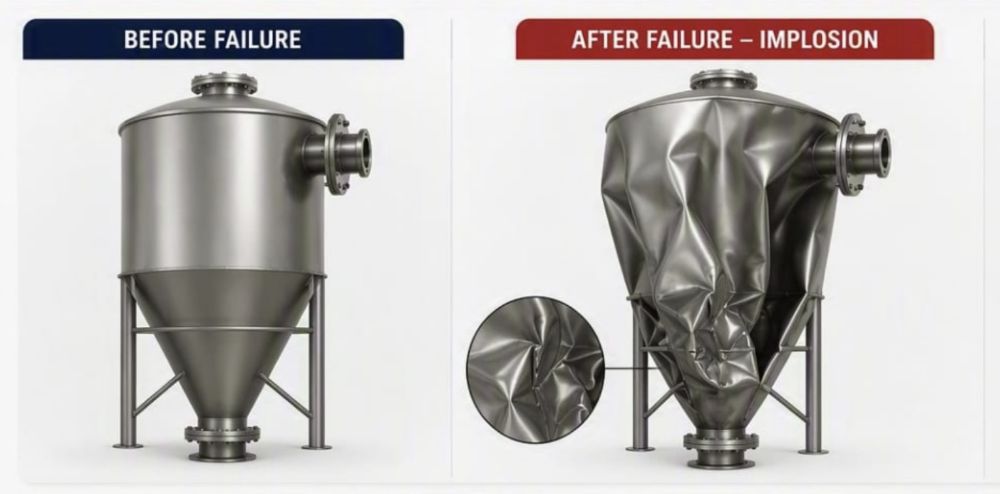
A few weeks ago, I visited a manufacturing site where a newly installed hopper imploded during start-up. The hopper was brand new and intended to be used for vacuum conveying. It had never been in production. During commissioning, the system generated severe internal vacuum conditions that the vessel was not rated to withstand. It collapsed inward.
The structural damage was extensive. Project timelines were disrupted. Significant recovery work was required before operations could resume.
Fortunately, nobody was injured.
As engineers, we spend most of our time thinking about throughput, capacity, and process performance. This incident reminded me that structural integrity and process safety belong at the same design discussion table.
What is the Purpose of a Hopper in Material Handling?
A hopper is a vessel designed to receive, temporarily hold, and discharge bulk material in a controlled manner into the next stage of the process. In industrial systems, hoppers sit above mixers, blenders, weighing stations, and conveying inlets. Aside from containing materials, hoppers also regulate their flow.
Hoppers can be gravity fed, but in this case, the hopper was fed through a vacuum conveying system.
Many fail to remember that a hopper is also a structural component. It must withstand every foreseeable operating condition, including conditions that arise during commissioning, start-up, shutdown, blockage events, and process upsets. The design cannot account only for normal production.
In food and beverage manufacturing, hoppers are integral at virtually every stage of the material handling line, from bag tipping and silo discharge to in-process weighing and packaging feeds. The structural loading scenarios at each of those points differ considerably.
A Brand-New Hopper. A Catastrophic Failure.
The hopper in question had been supplied as part of a larger plant upgrade. Nothing about it was improvised.
During commissioning, the system created vacuum conditions inside the vessel that exceeded its structural rating. There were little to no measures taken to prevent this, as the hopper was assumed to be sufficiently strong. The result was an implosion: the hopper collapsed inward under external atmospheric pressure. Flat or lightly reinforced walls, when subjected to negative pressure, experience compressive loading across their entire surface. Without explicit design allowance, the structure fails.
Vacuum loading is a foreseeable condition in powder handling equipment, particularly where the system relies upon vacuum conveying. Systems that operate under negative pressure create those conditions by design, and every vessel in the circuit must be rated accordingly.
What stayed with me was not the scale of the damage. It was that the failure occurred during commissioning, when design assumptions meet operational reality for the first time. It’s frequently the most demanding loading scenario a vessel will ever face.
What the Incident Revealed About Design Responsibility
Good hopper design requires more than specifying geometry and capacity. Every vessel must be evaluated against its full operating envelope: normal production, start-up, shutdown, blockage conditions, and commissioning sequences. Further, it is important to consider the surrounding process and whether added safety measures could be introduced.
Vacuum rating is part of that envelope, so is the question of whether structural calculations have been reviewed by someone who understands the process, not just the vessel in isolation. A structural engineer working from a static load case may not account for the dynamic pressure transients that occur during a pneumatic conveying equipment start-up.
That is not a failure of individual competence. It is a failure of scope.
When design responsibility is fragmented across multiple contractors, critical conditions fall through the gaps. The project planning stage must settle who owns the complete engineering picture.
Why On-Site Commissioning Support Cannot Be Replaced

The failure of the above system also occurred whilst the concerned supplier was undertaking remote commissioning. As the industry moves toward remote engineering and commissioning, cost efficiency, reduced travel, and faster project timelines become advantages. I understand the logic.
But real-world operating conditions do not always match design assumptions. When a system starts up for the first time, an experienced engineer on site can spot subtle deviations in pressure readings, flow patterns, and mechanical behaviour before they appear in remote monitoring data.
Complex bulk material handling systems require engineering judgement, direct observation, and rapid decision-making during commissioning. You can’t transfer that over a video call.
The difference between catching a warning sign early and missing it can be the difference between a minor process disruption and the kind of structural failure and workplace safety compromise I witnessed.
What I Took Away, and What Clients Should Ask Before Signing
The biggest lesson from this visit was not about vacuum loading or structural calculations.
It was about what happens when something goes wrong, and who is standing next to you when it does.
When evaluating suppliers for any bulk material handling project, the engineering scope matters as much as the equipment specification. You should be asking:
- Does the supplier understand the complete process, not just the equipment they are supplying?
- Has the design been verified for all operating and upset conditions, not just steady-state production?
- Are appropriate safeguards and protection measures incorporated into the design?
- Will experienced engineers be available on site during commissioning?
- Does the supplier take ownership when things do not go according to plan?
In material processing industries, equipment failures are rarely measured by the cost of the damaged steel alone. The real costs are lost production, safety issues, project delays, emergency repairs, and management distraction, often at multiples of the original equipment value.
The lowest-cost solution is not always the lowest-cost outcome.
Engineering is ultimately about anticipating problems before they arise. The best projects are not the ones that never face challenges. They are the ones where the right people are present when challenges arrive.
Choose partners, not just products.
At Pneu Powders Systems, our engineers are involved from initial design through to on-site commissioning across food, pharmaceutical, dairy, and petrochemical facilities in Singapore and across ASEAN. Contact our team to discuss your next bulk handling or storage silo project and ensure safety through all your powder handling processes.

